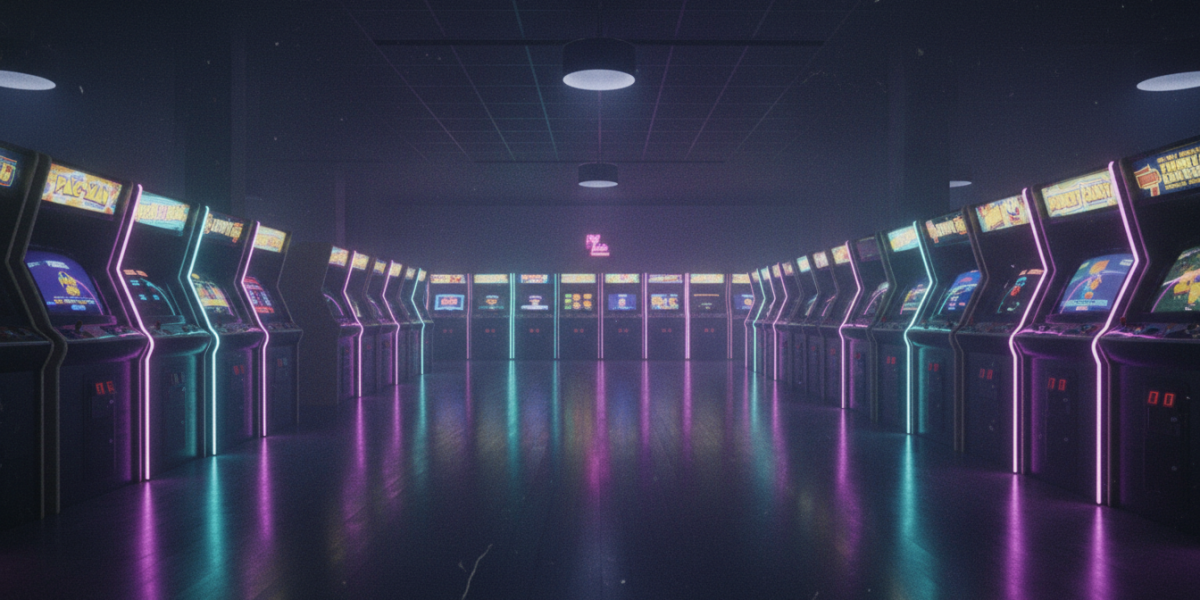
Step into the dimly lit halls of memory, where the symphony of bleeps, bloops, and synthesized explosions once filled the air. The golden age of arcade gaming — roughly spanning from the mid-1970s through the early 1990s — was more than just an era of entertainment. It was a cultural revolution that shaped an entire generation and laid the foundation for the modern video game industry.
The Birth of an Industry: 1970s Pioneers
It all began in earnest with Atari’s Pong in 1972 — a simple table tennis simulation that nevertheless captivated the public imagination. Nolan Bushnell and Ted Dabney had created something entirely new: an interactive electronic experience anyone could play. Coin-operated machines began appearing in bars, bowling alleys, and shopping centers across America, seeding the ground for what would become a global phenomenon.
The late 1970s saw a cascade of innovations. Space Invaders (Taito, 1978) became the first true arcade blockbuster, creating such demand that Japan experienced a shortage of 100-yen coins. The game introduced the concept of a high score, giving players a tangible reason to return and compete. Meanwhile, Atari’s Asteroids (1979) pushed vector graphics to stunning effect and introduced the initials-entry high score screen — a social feature that would become an arcade staple for decades.
The Golden Age Ignites: Pac-Man and the 1980s Explosion
If Space Invaders lit the fuse, Pac-Man (Namco, 1980) was the explosion. Designed by Toru Iwatani with the intention of appealing to a broader audience — including women and non-gamers — Pac-Man transcended gaming to become a true pop culture icon. The character spawned merchandise, a Saturday morning cartoon, a hit pop song, and an estimated 30 billion quarters in revenue. Pac-Man proved that video game characters could have personalities and that games could be more than shooting galleries.
Nintendo entered the arcade scene with explosive force via Donkey Kong (1981), introducing the world to a certain mustachioed carpenter named Jumpman — who would later be known as Mario. The game pioneered platform gaming mechanics and narrative structure in arcade games, with a simple but compelling story driving gameplay across multiple stages. Shigeru Miyamoto’s design philosophy — creating gameplay challenges that escalated naturally in difficulty — would define action gaming for generations.
The early 1980s became a flood of creativity and competition. Galaga, Centipede, Defender, Frogger, Zaxxon, and Q*bert all vied for quarters in an increasingly crowded marketplace. Each title introduced new mechanics, new visual styles, and new challenges. Arcade operators scrambled to acquire the latest hits, and players developed genuine expertise — mastering patterns, memorizing enemy behaviors, and chasing world records.
The Arcade as a Cultural Space
To understand the golden age of arcades, you must understand what arcades were — not merely as entertainment venues, but as social spaces. The local arcade was where neighborhoods gathered, friendships were forged, and rivalries were born. Unlike the solitary experience of home gaming, arcades were communal by nature. A crowd would gather around a player attempting to beat a high score. Strangers traded tips and strategies. The machines themselves were temples of aspiration, their attract screens looping endlessly like sirens beckoning passersby.
The arcade cabinet was also a work of art. Manufacturers invested heavily in cabinet design, control schemes, and artwork. Games like Tron (Bally Midway, 1982) featured elaborate backlit cabinets that were as visually striking as their gameplay. Dragon’s Lair (Cinematronics, 1983) used LaserDisc technology to deliver animated film-quality visuals — players paid double the standard quarter just to experience it. These weren’t mere game machines; they were spectacles.
Technical Innovation: Pushing the Hardware
The golden age was also a period of extraordinary technical innovation. Arcade hardware consistently outpaced home computers and consoles by years, giving developers the power to create experiences that simply couldn’t be replicated at home. Sega’s OutRun (1986) used a custom scaling chip to deliver the illusion of true 3D racing, complete with a branching path system and a memorable FM synthesizer soundtrack that players could choose before racing. Sitting in the hydraulically actuated deluxe cabinet, it was as close to a theme park ride as a video game had ever come.
Namco’s System 21 hardware enabled true polygon-based 3D graphics in titles like Winning Run (1988) and Air Combat, years before home consoles could dream of such technology. Meanwhile, Sega’s After Burner and Space Harrier pushed pseudo-3D scaling and rotation to dizzying speeds, creating sensory experiences that made arcade visits feel genuinely thrilling.
Fighting Games and the Second Wave: Late 1980s to Early 1990s
Just as some observers began predicting the arcade’s decline — with home consoles growing increasingly capable — a new genre emerged to breathe fresh life into the medium. Street Fighter II: The World Warrior (Capcom, 1991) redefined competitive gaming. The one-on-one fighting game format, with its roster of distinct characters, special move inputs, and deep competitive mechanics, created an entirely new reason to visit arcades: to compete against other human players.
Street Fighter II generated an estimated $1.5 billion in revenue during its arcade run. It inspired a genre, spawned sequels and imitators, and transformed arcades into competitive arenas. Mortal Kombat (Midway, 1992) followed with its digitized graphics and controversial fatality system, generating both massive sales and a United States Senate hearing that would ultimately lead to the creation of the ESRB rating system. Fighting games elevated arcade culture to a true competitive sport, with tournaments drawing players from across the country.
The beat-em-up genre also flourished in this era. Double Dragon (Technos, 1987), Final Fight (Capcom, 1989), Streets of Rage, and Teenage Mutant Ninja Turtles (Konami, 1989) offered cooperative multiplayer experiences that arcades were uniquely positioned to deliver. Standing shoulder-to-shoulder with friends, feeding quarters into a machine together, was a bonding experience unlike anything available on home systems of the time.
The Decline — and Why It Happened
The decline of the arcade golden age was not sudden but gradual — a slow erosion driven by multiple forces. The Super Nintendo and Sega Genesis brought genuine arcade-quality experiences into living rooms by the early 1990s. The SNES port of Street Fighter II, while imperfect, demonstrated that the gap between arcade and home was closing. Why spend quarters at an arcade when you owned the game?
The PlayStation and Nintendo 64 completed the transition. By the mid-1990s, home systems could deliver experiences that matched or exceeded what most arcades offered. Arcades attempted to stay relevant through increasingly elaborate hardware — deluxe motion-simulator cabinets, network-connected machines, rhythm games like Dance Dance Revolution — but the fundamental economics had shifted. The social function of arcades began migrating to LAN parties, then online gaming, then the internet itself.
The Legacy Lives On
The golden age of arcade gaming left an indelible mark on everything that followed. The design principles pioneered in coin-op classics — escalating difficulty curves, the pursuit of mastery, high score competition, memorable characters, and tight, responsive controls — remain the foundation of modern game design. Indie developers consciously evoke the era with pixel art aesthetics and arcade-style mechanics. Barcades have transformed classic machines into social lubricants for a new generation. Retro gaming communities preserve, restore, and celebrate these machines with a reverence typically reserved for museum artifacts.
When you play a modern game with tight controls and a scoring system, when you watch a speedrunner optimize their route to the millisecond, when you feel the electric thrill of beating your personal best — you are experiencing the direct legacy of those coin-operated pioneers. The golden age of arcade gaming may have had its sunset, but its light continues to illuminate everything we play today.
What’s your fondest arcade memory? Drop your favorite classic game in the comments — and don’t forget to check out our Vault for more retro gaming history.
Leave a Reply