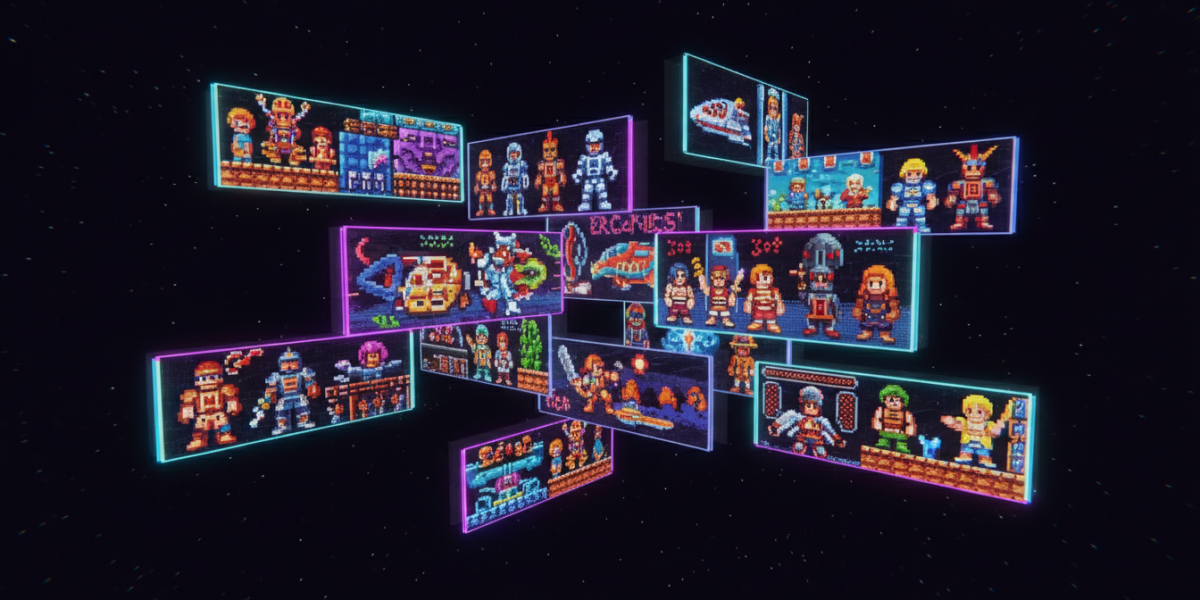
Pixel art is not a limitation — it is a language. Born of hardware constraints that demanded creativity within rigid boundaries, pixel art evolved from technical necessity into a celebrated aesthetic form. Today, games deliberately choose pixel art not because they must, but because nothing else communicates the same warmth, clarity, and nostalgic resonance. These are the 20 greatest pixel art games ever made, ranked by their artistic vision, cultural impact, and the mastery of their craft.
20. Shovel Knight (2014) — Yacht Club Games
A love letter to the NES era that surpasses many of its inspirations. Shovel Knight’s pixel art is meticulous — each character sprite bursts with personality, each environment tells a story through careful detail. Yacht Club Games studied the actual technical limitations of the NES and chose to work within them even on modern hardware, resulting in authentic-feeling art that nevertheless achieves a level of polish the original hardware could never have produced. The game proved that homage could be genuinely excellent rather than merely nostalgic.
19. Hyper Light Drifter (2016) — Heart Machine
Alex Preston’s masterwork uses pixel art as a vehicle for mystery and melancholy. The game’s world — pastel-hued ruins of an advanced civilization — is conveyed entirely through visual storytelling, with almost no dialogue or text. Every environmental detail is intentional, every color palette shift meaningful. Hyper Light Drifter demonstrates that pixel art can carry emotional weight equivalent to any cinematic art style, proving the medium’s expressive range.
18. Final Fantasy VI (1994) — Square
The apex of the Super Nintendo’s graphical capabilities and one of gaming’s most ambitious narratives rendered in pixel form. Final Fantasy VI’s sprites convey genuine pathos — Terra’s despair, Kefka’s madness, Celes’s courage — through subtle animation and careful design. The opera sequence, depicting an elaborate theatrical performance through pixel art and SNES audio, remains one of the most emotionally resonant moments in RPG history. This is pixel art serving story at the highest level.
17. Terraria (2011) — Re-Logic
With over 45 million copies sold, Terraria is proof that pixel art can anchor one of gaming’s most expansive worlds. The game’s biomes, enemies, items, and events — totaling thousands of distinct sprites — maintain a coherent visual identity despite their enormous variety. Re-Logic’s continued updates have expanded the game’s pixel art vocabulary without breaking its aesthetic unity. Terraria is pixel art as worldbuilding, demonstrating that the style can support games of extraordinary scope.
16. Castlevania: Symphony of the Night (1997) — Konami
The crown jewel of the Metroidvania genre is also a showcase for what late-era 2D pixel art could achieve. Dracula’s castle is rendered in extraordinary detail, with backgrounds that drip Gothic atmosphere — candelabras casting real-time shadows, fog rolling across moonlit courtyards, stained glass windows filtering colored light. Alucard’s animations are fluid and aristocratic, his cape physics ahead of their time. Symphony of the Night represents the full flowering of 2D pixel art before the industry pivoted to 3D.
15. Hollow Knight (2017) — Team Cherry
A team of three Australians created a hand-crafted underground kingdom that rivals the scope of AAA productions. Hollow Knight’s art style is technically hand-drawn animation rendered as sprites — each enemy, NPC, and environment was individually illustrated, giving the game an organic quality that pure pixel work rarely achieves. The forgotten kingdom of Hallownest is haunting, beautiful, and richly detailed. Team Cherry proved that small teams with extraordinary vision can produce world-class visual art.
14. Spelunky (2008 / 2012) — Mossmouth
Derek Yu’s procedurally generated spelunker is a masterclass in readable pixel art. Because Spelunky’s levels are randomly generated, every sprite must communicate its function instantly and unambiguously — traps must look dangerous, treasure must look enticing, enemies must telegraph their behavior. The game’s art style achieves this with remarkable clarity while maintaining a charming, adventurous personality. It is pixel art in service of game design, where every pixel serves a functional purpose.
13. Mega Man 2 (1988) — Capcom
Within the NES’s severe constraints — a 256×240 resolution, 54-color palette, and strict sprite limits — Capcom’s team created one of gaming’s most iconic visual vocabularies. Each Robot Master is instantly recognizable and perfectly communicates their elemental theme through design alone. Mega Man himself, that inimitable blue rectangle with a cannon arm, is one of gaming’s most enduring character designs. The simplicity is the art — every pixel placed with purpose, nothing wasted.
12. EarthBound (1994) — Ape / HAL Laboratory
EarthBound’s pixel art is unlike anything else in gaming — deliberately strange, psychedelically colored, and dripping with suburban Americana rendered surreal. Shigesato Itoi and his team created a visual world where mundane settings (diners, department stores, baseball diamonds) coexist with cosmic horror and alien weirdness, all rendered in a cheerful SNES palette that makes the darkness more unsettling by contrast. The game’s visual style is inseparable from its emotional impact.
11. The Secret of Monkey Island (1990) — LucasArts
Ron Gilbert and Steve Purcell’s pirate comedy adventure demonstrated that pixel art could be cinematic. The hand-painted backgrounds — rendered at VGA resolution with 256 colors — established a visual standard for adventure games that persisted for years. Characters were expressive, environments detailed and atmospheric. The famous sunset scene on Melee Island’s beach is as evocative today as when it was rendered — proof that good art transcends technical limitations.
10. Superbrothers: Sword & Sworcery EP (2011) — Capybara Games
A deliberate deconstruction of pixel art conventions that arrived as a meditation on games themselves. Sword & Sworcery uses a low-resolution, impressionistic pixel style that prioritizes mood and atmosphere over detail — its forests and moonlit landscapes are haiku-like in their economy. The game sparked a renewed critical conversation about pixel art as a conscious aesthetic choice rather than a technical constraint, influencing an entire wave of indie developers.
9. Chrono Trigger (1995) — Square
With character designs by Dragon Ball creator Akira Toriyama, Chrono Trigger’s pixel art carries the weight of manga illustration translated into sprite form. The game’s time periods — from prehistoric prehistory to a post-apocalyptic future — each have distinct visual palettes and design languages, creating a cohesive world across radically different eras. The combat animations, unprecedented in SNES RPGs, gave characters genuine physical presence. Chrono Trigger is collaborative artistry at its finest.
8. Stardew Valley (2016) — ConcernedApe
Eric Barone spent four years creating every pixel in Stardew Valley alone. The result is a farming simulation that radiates warmth and care through its art — the seasons shift with subtle color palette changes, the characters express personality through minimal but expressive sprites, the farm transforms visually with the player’s investment. Stardew Valley’s pixel art communicates coziness and possibility with extraordinary efficiency. It is the work of a single artist in complete creative control, and it shows.
7. Hotline Miami (2012) — Dennaton Games
Jonatan Soderström and Dennis Wedin weaponized pixel art. Hotline Miami’s top-down perspective and deliberately crude sprites serve a purpose: they abstract the game’s extreme violence to the point of surreality, creating a queasy cognitive dissonance that is central to the game’s commentary on power fantasies and violence in media. The neon-drenched, hallucinatory visual style — all hot pinks and sickly greens — is unforgettable. This is pixel art with artistic intent, not aesthetic nostalgia.
6. Undertale (2015) — Toby Fox
Toby Fox’s one-person RPG revolution uses deliberately simple pixel art as both technical constraint and narrative tool. The lo-fi sprites — which Fox has acknowledged are not technically sophisticated — create a visual language of innocence that makes the game’s emotional moments hit harder by contrast. When Undertale’s characters express sorrow, fear, or joy through their simple pixel faces, the effect is paradoxically more moving than polished 3D animation. Undertale proved that emotional resonance has nothing to do with graphical fidelity.
5. Contra (1987) — Konami
The NES Contra is a masterpiece of kinetic pixel art — soldiers flip, tumble, and blast through environments that feel genuinely dangerous and alive. Konami’s artists captured the cinematic language of 1980s action films (Aliens, Predator, Commando) in pixel form with remarkable fidelity. The alien hive stages, in particular, create a genuinely unsettling biological atmosphere within the NES’s tight constraints. Contra’s pixel art is in constant motion, designed to thrill with every frame.
4. The Legend of Zelda: A Link to the Past (1991) — Nintendo
Nintendo’s masterwork defined the visual language of top-down adventure gaming. The dual-world structure — Light World and Dark World rendered with distinct but complementary palettes — is communicated entirely through art direction. Link’s animations convey weight and responsiveness; the environments balance navigational clarity with atmospheric detail. A Link to the Past established standards for pixel art readability and world-building that designers study to this day. It remains visually impeccable more than three decades after release.
3. Celeste (2018) — Maddy Thorson & Noel Berry
Celeste’s pixel art is in service of something profound. Maddy Thorson’s mountain climbing platformer uses its visual design to externalize its protagonist’s mental state — the crisp, readable pixel art of Madeline’s sprite contrasting with increasingly abstract and unstable environments as the game delves into themes of anxiety and depression. The pixel art is precise where it needs to be for gameplay, atmospheric where it serves narrative, and technically dazzling in its use of color to signal emotional shifts. Celeste demonstrated that pixel art can be literary.
2. Pokemon Red and Blue (1996) — Game Freak
Within the Game Boy’s four shades of green, Ken Sugimori and the Game Freak team created 151 distinct, recognizable creatures that would go on to become one of the most valuable intellectual properties in human history. The original Pokemon sprite work is a triumph of silhouette design — each creature communicates its type, personality, and evolutionary stage through its outline alone. Pikachu, Gengar, Mewtwo: instantly recognizable at any resolution, in any context. This is pixel art achieving something that transcends gaming.
1. Super Mario Bros. (1985) — Nintendo
Forty years later, the pixel art of Super Mario Bros. remains the most recognized visual language in gaming history. Shigeru Miyamoto and Takashi Tezuka designed Mario’s overalls and hat not as aesthetic choices, but to solve technical problems — overalls showed arm movement without animation, the hat avoided hair rendering, the mustache replaced a mouth. Technical constraints became iconic design. Every element of Super Mario Bros.’ visual vocabulary — the brick blocks, the mushrooms, the flagpoles, the pipes — is instantly legible, perfectly functional, and universally beloved. It is the foundation upon which everything else in this list was built, and the standard against which all pixel art is still measured.
The debate never ends — what pixel art game deserves a spot on this list? Share your picks in the comments. And if you want to dive deeper into gaming history, explore our Vault for more retro gaming coverage.
Leave a Reply