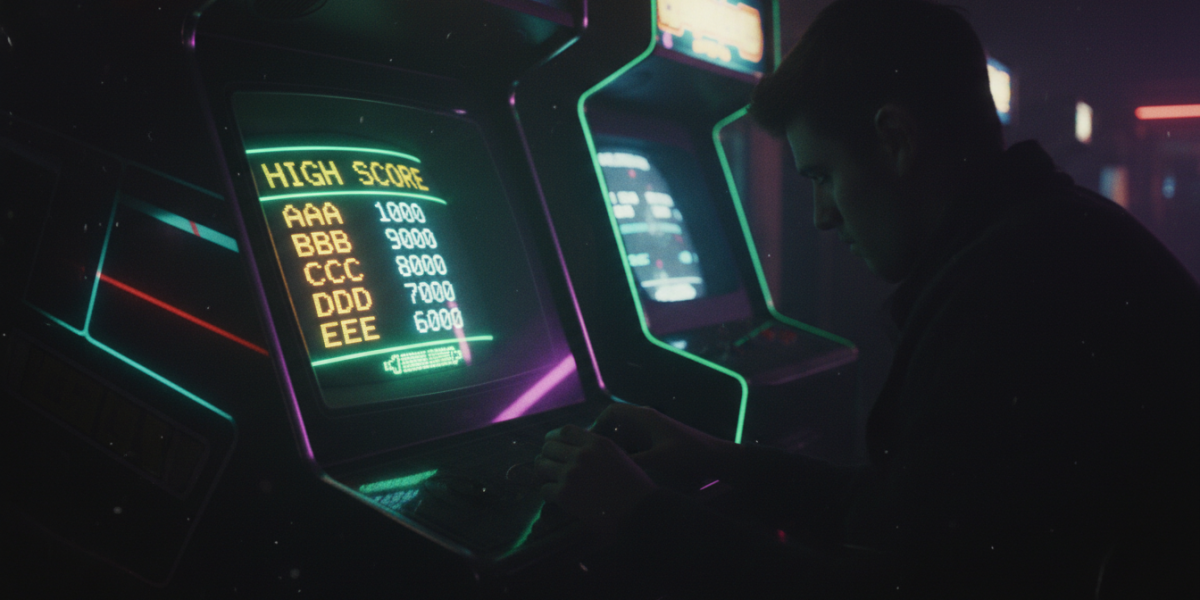
Three letters. That’s all you got. After feeding quarters into a machine for an hour, after threading your way through wave after wave of alien invaders or outrunning a ghost through a maze, after reaching a score that no one in this arcade — maybe no one in this zip code — had ever achieved, the machine gave you three letters to immortalize yourself. Your initials. Your proof. Your legacy.
The high score table was the original social media — a leaderboard visible to everyone who walked past, a permanent record that said: someone was here, and they were great. No likes, no followers, no algorithm. Just three letters and a number that either impressed you or it didn’t.

The Birth of the High Score
Space Invaders (1978) didn’t invent scoring, but it transformed the concept entirely. For the first time, the machine remembered your score after the game ended. Players could see what the best score in the building was. They could try to beat it. This simple innovation — the persistent high score — turned passive entertainment into active competition, and it kept players pumping quarters long after they’d seen everything the game had to offer.
Asteroids (1979) went one step further and added name entry, letting players claim their scores with initials. Suddenly the high score table was personal. “AAA” at the top meant someone had been here and dominated. The arcade was no longer just a place to play games — it was a competitive arena with public rankings and social stakes, and everyone who walked in could see exactly who was winning.
The machine didn’t care who you were. It didn’t offer catch-up mechanics or difficulty scaling. You either got the score, or you didn’t.
The Twin Galaxies Era
In 1981, Walter Day opened Twin Galaxies arcade in Ottumwa, Iowa, and began meticulously recording world record scores. He established standardized rules for competitive play and created the first centralized database of verified high scores. Twin Galaxies became the official keeper of arcade records — the institution that transformed casual competition into formal sport, complete with rulebooks, referees, and disputes.
Day’s referee network spread across North America. Players at any participating arcade could attempt world records under official observation. The organization published score rankings in gaming magazines and worked with Guinness World Records to certify achievements. Competitive gaming had its governing body decades before esports existed as a concept — long before anyone thought to put “professional” and “gamer” in the same sentence.
Donkey Kong and the Perfect Storm
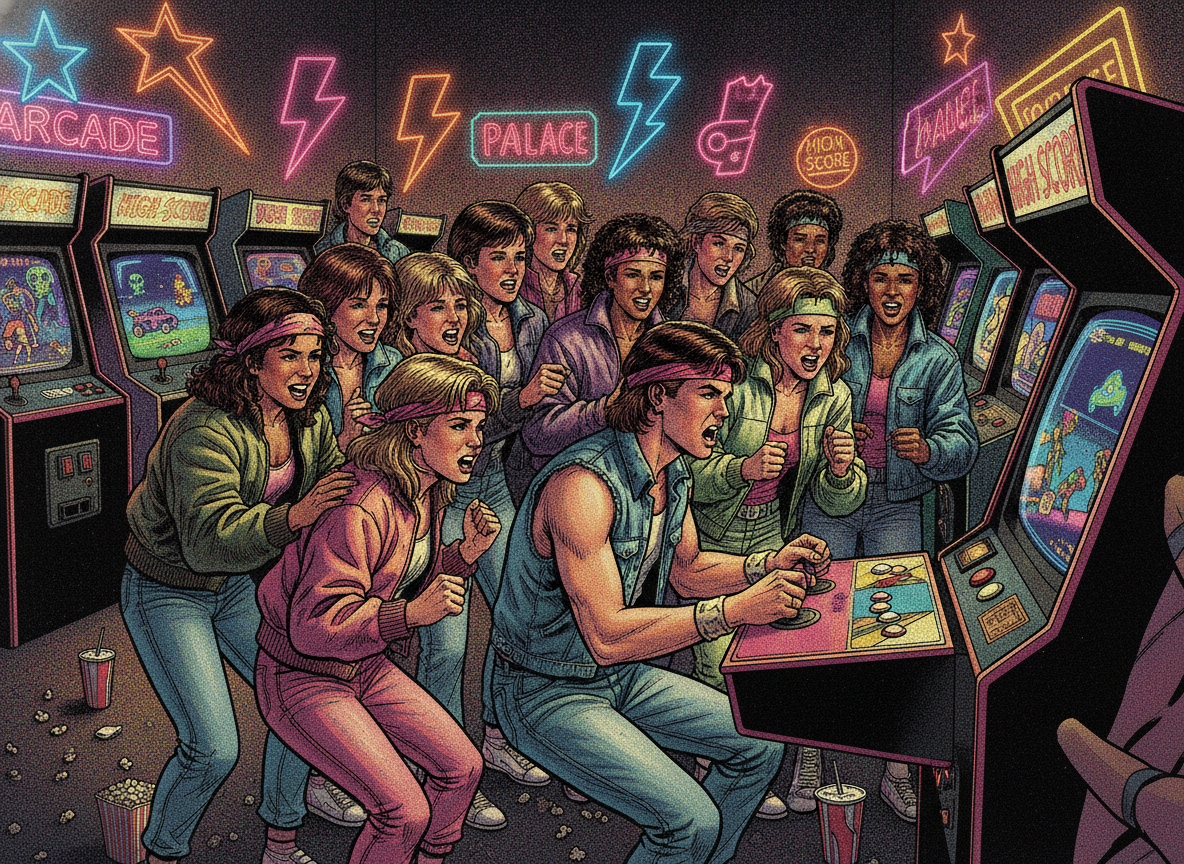
No game embodied competitive retro gaming more completely than Donkey Kong. Introduced in 1981, the game’s escalating difficulty and infamous kill screen — the glitched level 22 where the game becomes unwinnable due to a timer bug — created a natural ceiling that made high score chasing uniquely compelling. How close could you get to the maximum possible score before the game killed you?
The rivalry between Billy Mitchell and Steve Wiebe — documented in the 2007 film The King of Kong — brought this world to mainstream attention. Mitchell’s near-mythic status as the first person to achieve a perfect score in Pac-Man, combined with his Donkey Kong records, made him competitive gaming’s first genuine celebrity. The film exposed the human drama, ego, and community politics lurking beneath the pixelated surfaces — proof that wherever there’s a scoreboard, there’s a story worth telling.
Landmark Scores That Changed the Game
A handful of achievements stand out as true turning points in competitive arcade history — moments where a number on a screen became a legend in its own right:
| Game | Player | Achievement | Year |
|---|---|---|---|
| Donkey Kong | Billy Mitchell | First 1,000,000+ point score | 1982 |
| Pac-Man | Billy Mitchell | First verified perfect game (3,333,360 pts) | 1999 |
| Asteroids | Scott Safran | Landmark million-point run | 1982 |
| Donkey Kong | Steve Wiebe | Record run central to The King of Kong | 2005 |
| Super Mario Bros. | Speedrun community | Sub-5-minute clears popularized | 2010s |
The Pac-Man Perfect Game
Pac-Man’s competitive history produced one of gaming’s most extraordinary achievements: the perfect game. To pull it off, a player must complete all 255 playable boards, eating every single dot, power pellet, fruit, and ghost on every board without losing a life. The game then hits a split screen on board 256 — a memory overflow bug that turns the right side of the screen into a garbled mess of symbols — effectively ending play.
Billy Mitchell achieved the first verified perfect Pac-Man score of 3,333,360 points on July 3, 1999. It took approximately six hours of uninterrupted play. The achievement required not just skill but an encyclopedic knowledge of ghost patterns, power pellet timing, and the discipline to hold total concentration for the length of a full workday. Fewer than a dozen people have achieved a perfect Pac-Man score in the decades since — a club smaller than most Olympic podiums.
Speedrunning: High Score’s Spiritual Successor
As home consoles replaced arcades, the high score table evolved. Without the quarter-fed pressure of the arcade floor, home players developed new metrics. Speedrunning — completing a game in the minimum possible time — became the new measure of mastery. Sites like Speedrun.com now catalog hundreds of thousands of records across thousands of games, with communities of dedicated players discovering new routes, glitches, and optimizations constantly.
The Games Done Quick charity marathons bring speedrunning to mainstream audiences, raising millions for charity while showcasing the extraordinary depth of knowledge competitive retro gamers accumulate. Watching a skilled speedrunner tear through Super Mario Bros. in under five minutes is as impressive as any conventional athletic performance — a combination of reflexes, memorization, and technical precision honed over thousands of hours of practice.
The Score That Matters
Competitive retro gaming endures because numbers have meaning. Unlike modern games’ endless progression systems designed to keep players subscribing, the arcade high score was pure. The machine didn’t care who you were. It didn’t offer catch-up mechanics or difficulty scaling. You either got the score or you didn’t — no shortcuts, no microtransactions, no mercy.
That brutal honesty — that meritocratic simplicity — is increasingly rare in a gaming landscape optimized for engagement metrics and monetization. The high score table asked only one question: how good are you? And it remembered the answer in three letters, forever.
Enter your initials. Claim your place. The machine is watching.
Leave a Reply