Before orchestras were sampled digitally, before MP3s and streaming playlists existed, video game music was born from constraint. Programmers coaxed melody, harmony, and emotion from chips with mere kilobytes of memory and a handful of sound channels. The result was chiptune — a genre so distinctive, so deeply encoded in cultural memory, that its bleeps and bloops can transport an entire generation back to 1987 in an instant.
The Hardware Behind the Sound
Every memorable chiptune sound traces back to silicon. The NES used the Ricoh 2A03 chip, which provided two pulse wave channels, a triangle wave, a noise channel, and a DPCM sample channel — five voices total. What composers achieved with those five voices remains astonishing. Mega Man 2, Castlevania III, Contra — these soundtracks were composed under severe hardware limitations and emerged as genuine artistic achievements.
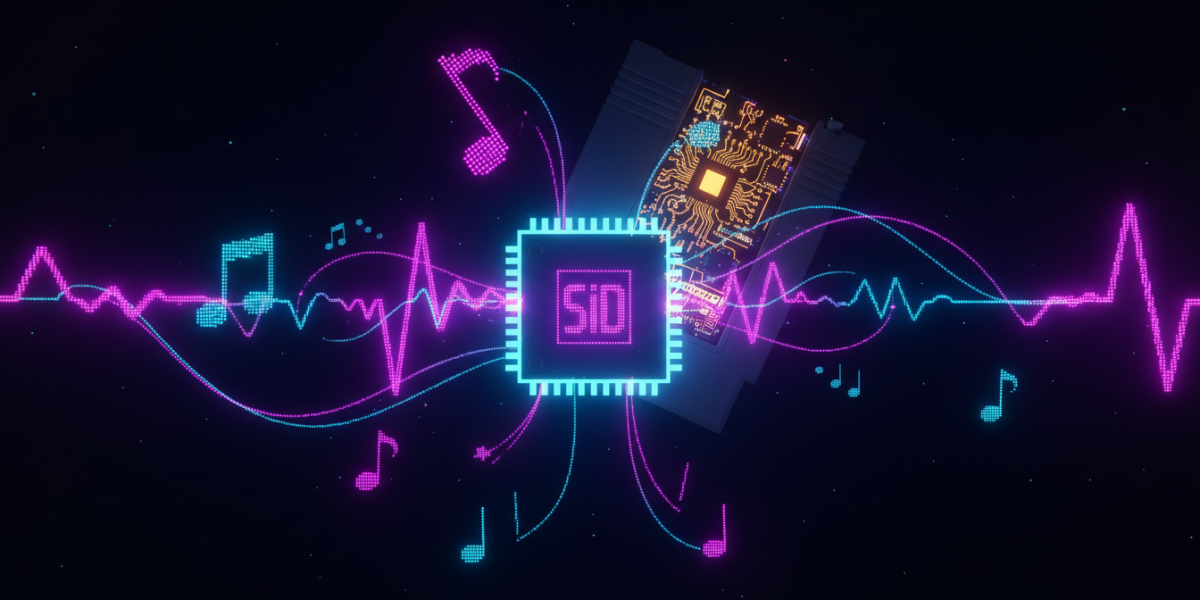
Commodore 64 owners knew the MOS Technology SID (Sound Interface Device) — arguably the most beloved sound chip in gaming history. The SID’s three oscillators, ring modulation, and filter capabilities gave it a warmth and complexity that felt almost analog. Composers like Rob Hubbard and Martin Galway pushed the SID to produce music that rivaled contemporary pop productions.
Sega’s Genesis featured the Yamaha YM2612 FM synthesis chip alongside a Texas Instruments PSG. The FM synthesis approach created that distinctive metallic, punchy sound — perfect for Streets of Rage 2‘s industrial club music or Sonic the Hedgehog‘s upbeat platformer grooves. It was a completely different palette from Nintendo’s warmer, rounder NES sound.
The Composers Who Became Legends
Koji Kondo composed the Super Mario Bros. theme in 1985 — arguably the most recognized piece of music in history. Working within NES constraints, he created something timeless: an overworld theme so perfectly constructed that it functions as a self-contained pop song with verses, bridges, and a hook that lodges permanently in human memory.
Nobuo Uematsu defined an entire era of RPG composition through the Final Fantasy series. From the sparse 8-bit compositions of the NES originals to the lush SNES soundscapes of Final Fantasy VI, Uematsu’s melodies carried emotional weight that the primitive graphics alone could never achieve. Players wept at the opera scene in Final Fantasy VI — a sequence whose emotional power came almost entirely from Uematsu’s score playing on the SNES sound chip.
Yuzo Koshiro’s work on Streets of Rage 2 remains a benchmark. Programming the Genesis’s FM chip directly in assembly language, Koshiro created industrial techno and house music years before those genres reached mainstream Western audiences. The Streets of Rage soundtrack sounds like it was made for a Berlin nightclub, not a 1992 beat-em-up — and that anachronistic quality makes it unforgettable.
The Aesthetic of Limitation
What makes chiptune special isn’t technical sophistication — it’s the opposite. The limitations forced creativity. With only three or four sound channels, composers couldn’t layer dozens of instruments. Every note had to work harder. Melodies had to be immediately memorable because there was no lush arrangement to carry a mediocre tune. The constraints produced music of extraordinary economy and clarity.
This principle — that constraint breeds creativity — has become a cornerstone of artistic philosophy far beyond gaming. The chiptune era proved that the richest art often emerges not despite limitations, but because of them.
Chiptune as a Living Genre
Chiptune never died. Artists like Anamanaguchi, Sabrepulse, and 8 Bit Weapon continue composing original music using vintage hardware — actual NES consoles, Game Boys, and Commodore 64s modified for live performance. The annual Blip Festival brought chiptune to New York art spaces and Tokyo clubs. Platforms like SoundCloud and Bandcamp host thousands of original chiptune tracks released every month.
Perhaps most remarkably, chiptune influences have permeated mainstream pop. Artists like Grimes, Anamanaguchi, and countless indie game developers incorporate chip sounds into productions that reach millions of listeners who may never have touched a Game Boy. The aesthetics of limitation have become a deliberate choice — a way to evoke nostalgia, authenticity, and a particular emotional frequency that no modern synthesizer quite replicates.
Why It Still Hits Different
There’s a neurological dimension to chiptune nostalgia that researchers are only beginning to understand. For millions of people who grew up with these sounds, the connection between chiptune audio and formative experiences — Saturday mornings, summer holidays, the feeling of mastering a difficult level — is deeply encoded. A four-note melody can trigger recall with more precision than almost any other sensory stimulus.
But chiptune also resonates with people who have no childhood connection to it. Younger listeners discover this music and respond to its directness, its energy, and its honesty. There’s no production trickery, no autotune, no quantized-to-perfection drum programming masking a weak composition. What you hear is exactly what the chip is doing — pure signal, pure intent.
The bleeps and bloops of 1985 became the soundtrack of a generation. Forty years later, they’re still playing — in bedrooms, on stages, and in the deepest circuits of our collective memory.
Leave a Reply