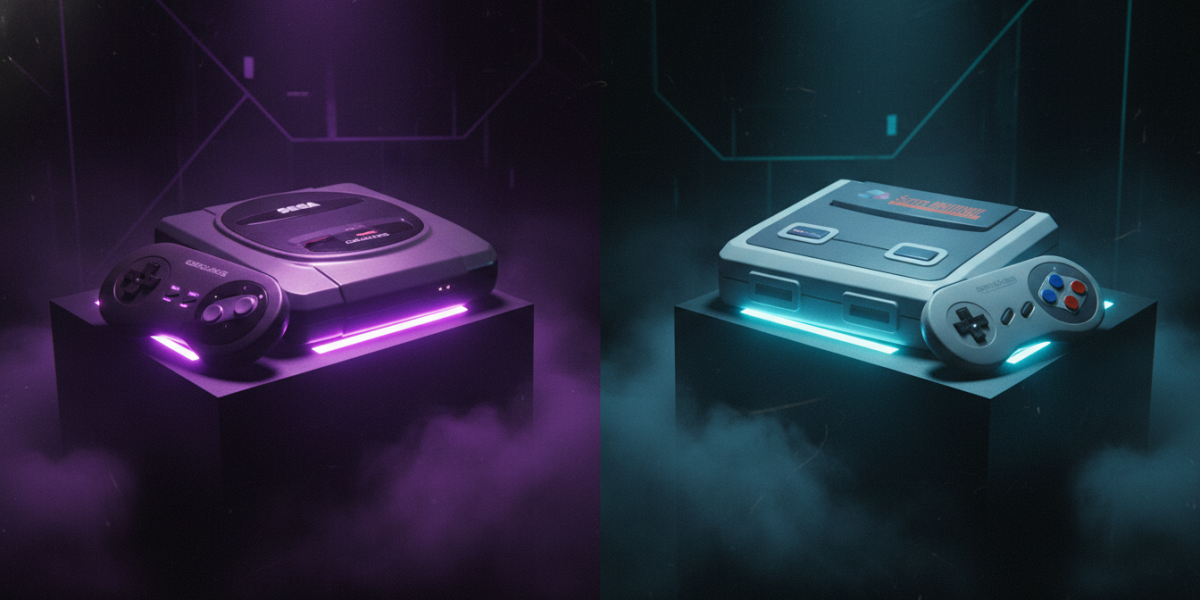
The early 1990s gave birth to one of the most ferocious battles in entertainment history — not fought with weapons, but with cartridges, mascots, and marketing budgets. The 16-bit console wars between Sega and Nintendo defined a generation of gamers and permanently shaped the video game industry we know today.
The Contenders
Nintendo had dominated the home console market since the NES revived the crashed industry in 1985. By 1990, the Super Nintendo Entertainment System (SNES) represented the pinnacle of Nintendo’s engineering — a 16-bit powerhouse with the revolutionary Mode 7 graphics, a stellar launch lineup, and the trusted Nintendo seal of quality.
Sega, forever the challenger, had already landed a blow with the Mega Drive (Genesis in North America) launching in 1988. But it was their marketing strategy that truly ignited the war. “Genesis does what Nintendon’t” wasn’t just a slogan — it was a declaration of cultural war.
Sonic vs Mario: The Battle of Mascots
Nintendo had Mario — the lovable plumber who had saved the gaming industry. Sega countered with Sonic the Hedgehog, a blue blur of attitude who embodied the “cool” factor Nintendo seemed to lack. Sonic was fast, edgy, and wore red sneakers. Mario wore overalls. The contrast was deliberate and devastatingly effective.
Sonic the Hedgehog (1991) became a cultural phenomenon overnight. The game’s blistering speed showcased what the Genesis could do, and Sega’s marketing team hammered the point home: if you wanted to be cool, you played Sega. This was youth marketing at its most aggressive, and it worked spectacularly in North America, where Sega actually outsold Nintendo for stretches of the early ’90s.
The Franchises That Defined Each Platform
Both machines boasted extraordinary software libraries that still hold up today. The SNES delivered Super Metroid, The Legend of Zelda: A Link to the Past, Chrono Trigger, Final Fantasy VI, and Super Mario World — a roster of masterpieces that reads like a hall of fame. The SNES sound chip, designed by Sony engineer Ken Kutaragi (who would later create the PlayStation), produced lush orchestral scores that the Genesis struggled to match.
The Genesis countered with Streets of Rage 2, Phantasy Star IV, Gunstar Heroes, Castlevania: Bloodlines, and the entire Sonic franchise. Its blast processing (largely a marketing term) and faster CPU made it the preferred platform for arcade ports and sports games. EA Sports built its empire on Genesis titles like John Madden Football.
The Blood Incident: Censorship and Culture Wars
The console wars weren’t just about games — they were about identity and values. When Mortal Kombat arrived in 1993, Nintendo famously censored the blood, replacing it with “sweat” and removing fatalities. Sega released the uncensored version with the blood code “ABACABB.” Sega won that round decisively in the court of adolescent opinion.
This incident, along with the Congressional hearings on video game violence that followed, ultimately led to the creation of the ESRB rating system in 1994 — a direct consequence of the console wars spilling into mainstream culture.
The Add-on Arms Race
Sega’s confidence — or perhaps hubris — led them down an expensive path of hardware add-ons. The Sega CD (1991) added CD-ROM capability and full motion video games. The 32X (1994) promised 32-bit power without a new console. Both devices fragmented the install base, confused consumers, and ultimately damaged Sega’s credibility.
Nintendo took the more conservative path, focusing on software quality. While the SNES received a handful of add-ons that never materialized (the ill-fated SNES-CD partnership with Sony birthed the PlayStation instead), Nintendo’s discipline kept their platform coherent and their library consistent.
The Aftermath and Legacy
By the mid-’90s, the battlefield was shifting. The SNES edged ahead globally, particularly in Japan and Europe. But both companies were already looking toward 32-bit and 64-bit successors. The Saturn and PlayStation launched in 1994, and Nintendo’s N64 followed in 1996. The 16-bit war was over.
Sega never recovered its market position. After the Dreamcast’s premature death in 2001, they exited the hardware business entirely, becoming the software company that now ports Sonic to Nintendo platforms — a surreal twist of fate that would have been unthinkable in 1992.
Yet the console wars’ legacy endures. They taught the industry the power of aggressive marketing, platform exclusivity, and mascot branding. They proved that video games were a mainstream cultural battleground, not just a children’s toy aisle. And they gave us two extraordinary machines whose software libraries represent some of the finest games ever made. The war may be over — but the classics live forever.
Leave a Reply